Eleanor and Marian

Eleanor and Marian

Tuesday, May 13, 2014

Writtings and artifacts


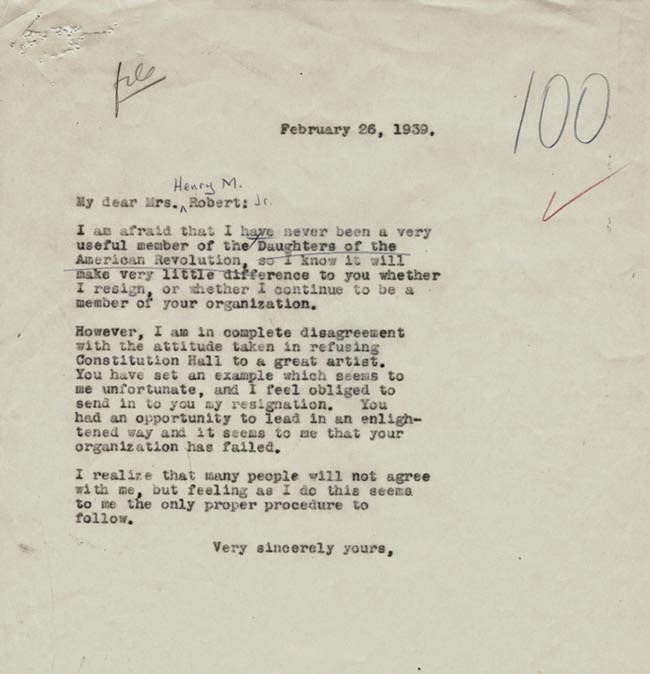
This is a telegram sent from the first lady to John Lovell, Jr. of Howard University. February 26, 1939
Eleanor Roosevelt resigned from the Daughters of the American Revolution (DAR) when it barred the world-renowned singer Marian Anderson, an African American, from performing at its Constitution Hall in Washington, DC. Following this  the federal government invited Anderson to sing at a public recital on the steps of the Lincoln Memorial. The DAR had adopted a rule excluding African-American artists from the Constitution Hall stage in 1932 following protests over "mixed seating," blacks and whites seated together, at concerts of black artists. On February 26, 1939, Mrs. Roosevelt submitted her letter of resignation to the DAR president. Mrs. Roosevelt told her readers of her daily column that in this situation, “To remain as a member implies approval of that action, therefore I am resigning.”


View of 75,000 people gathered to hear recital by Marian Anderson at the steps of the Lincoln Memorial, Easter Sunday, April 9, 1939
(National Archives, Still Picture Branch, 306-NT-965B-4 )
http://www.fdrlibrary.marist.edu/library/images/andersonmural.jpg
Sketch of the 1939 Lincoln Memorial Concert drawn by artist Mitchell Jamieson for his mural in the Interior Department Building, Washington, DC.
See a rough draft of Eleanor's news column speaking about the DAR here.


Monday, May 12, 2014

Who is Marian Anderson?


Marian Anderson was born in 1897 in South Philadelphia. At the heart of their community stood the Union Baptist Church. It was within these walls that Marian first began to sing. In this church was where she was soon ushered into the adult choir and her talent began to shine through at the age of 14. The church started a fund called the "Marian Anderson's Future Fund,"because they had such great faith in her ability to go far. Italian voice master, Giuseppe Boghetti remembers this first meeting as occurring "at the end of a long hard day, when I was weary of singing and singers, and when a tall calm girl poured out ‘Deep River' in the twilight and made me cry." While Philadelphia conservatories turned Marian away with the refusal, "We don't take colored," she quickly acquired influential fans who would aid her career. She went on to participate in a competition and that win prompted a European tour that brought about great fame among the people of Europe and she turned into a coveted performer. Despite the fact that she was the country's third highest concert box office draw, Marian was still subject to the racial bias of the time, especially in the United States.  The situation with the DAR brought about action by the first lady Eleanor Roosevelt and she was invited to sing at the steps of the Lincoln memorial on Easter Sunday. Feeling the meaning of the occasion, Marian had tears in her eyes when she delivered "Nobody Knows the Trouble I've Seen" and "America" with heart-breaking pathos. The event was so momentous and inspiring that the D.A.R. finally invited Marian to sing at the Hall in 1943 for a war relief concert. At that event, both black and white concert-goers attended.
Marian Anderson was the first African American invited to perform at the White House


FUN FACT: 
 In 1958 she was officially designated delegate to the United Nations, a formalization of her role as "goodwill ambassador" of the U.S. she played earlier, and in 1972 she was awarded the UN Peace Prize.


Marian Anderson Sings at Lincoln Memorial


This video show Marian Anderson on the steps of the Lincoln memorial Easter Sunday 1939. The recording allows you to hear her famous voice ring out to the ears of 75,00 people of all races gathering to hear a free concert and come together to her an African American singer preform in spite of the support against the concert.

Conclusion

I hope you enjoyed this stroll through a little piece of history. As you may have realized these two women have been extremely influential in multiple aspects. Eleanor Roosevelt is arguably the most influential first lady in history and her efforts to expel civil injustices has had rippling effects that spill over into even today. Marian Anderson crushed cultural boundaries and united people pf all races with her melodious voice and pride in her talent. Both women effected the others cause in positive manors and the singing at the Lincoln memorial that Easter Sunday was just one small example of what can happen through a few simple decisions. The aim of this exhibit was to show how history can intertwine and effect change without people realizing it. Thank you for your interest and please feel free to further your interest through perusing some of these links and learning more aout these two amazing women of history.
http://www.fdrlibrary.marist.edu/
Click Here to be taken to the official FDR museum website

Wednesday, May 7, 2014

Sources


Works Cited

"Anna Eleanor Roosevelt." The White House. The White House, n.d. Web. 01 May 2014.

"Franklin D. Roosevelt Presidential Library and Museum." Franklin D. Roosevelt
Presidential Library and Museum. N.p., n.d. Web. 04 May 2014.

Roark, Johnson, Cohen, Stage, Hartman. The American Promise 5th edition A history of
the United States, Boston: Bedford/St. Martin’s., 2002. Print.

Roosevelt, Eleanor. The Autobiography Of Eleanor Roosevelt. New York : Harper &
Bros., 1961. Print. 

Roosevelt, Eleanor. This I Remember. New York: Harper 1949. Print 

10 Things You May Not Know About the Roosevelts." History.com. A&E Television Networks, 20
             Dec. 2012. Web. 13 May 2014.
   
Urdang, Ivy P. "Franklin And Eleanor Roosevelt: Human Rights And The Creation Of
The United Nations." OAH Magazine Of History 22.2 (2008): 28-31. Academic
Search Premier. Web. 4 May 2014. 


Video Links:  
http://youtu.be/9yzakVOdh6k
       From the official FDR library YouTube account.
             
http://youtu.be/mAONYTMf2pk

Tuesday, April 22, 2014

Blog 8


Harry Lamin was a soldier in World War I. He is a brother to Kate, Mary, Annie, and Jack. He served in the 9th Battalion York & Lancaster Regiment seeing front line action in Flanders and Northern Italy from the end of 1916 to January 1920. He wrote letters during his time in his Battalion about his war experiences, conditions during the war, and keeps in touch on family affairs. His letters allude to many of the rough conditions we know were prevalent in World War I. For example, the short trousers that they had for the summer months, may make sense when thinking it is hot outside, but when you learn what was in the trenches and what they were standing in, often water, mud, remains, long pants would have surely been welcomed. Also,the letter mentions the trenches being a cramped place where bullets were flying and enemies were constantly bombarding. The secondary source about the battle of  Passchendaele talks of mud so deep they had to take six men to carry wounded or dead soldiers off of the battlefield. This specific battle had approximately 250,000 deaths because of the atrocious living conditions. The men were forced to live like barbarians because they were short of food, shelter and had to deal with over three feet deep mud. The summer that year was the rainiest one on record in years which was why the battle was so drawn out. The mud made for impossible battle conditions and it was the most the soldiers could do to stay alive. Harry seems to avoid going into great detail about these moments. I can understand why this particular battle might have been one he would most happily forget, to see such destruction and to be living in such a horrible environment must have been life altering. Therefore he chose to leave out many of the details for the letters he wrote back home about. He shares the simple things that happen more openly and tries to cover sad moments with a nonchalant response. Specifically when talking about his CO dying he called him a good man and did not elaborate more. I would assume that these letters were Harry’s way of keeping a connection to reality and a grip on his sanity. It seemed in his letters when he would ask for news on such trivial things, it was a way for him to have some peace of mind, that not everyone lived as he was at the time, that there was life happening “normally” even in the midst of the war. His style is shirt, friendly and as positive as any soldier could muster I am sure.


28.jpg (17703 bytes)
One of the picutre of the muddy battle of Passchendaele

Tuesday, April 8, 2014

Labor Leader

"When people ask me why are the immigrant families so poor?" I wonder if they are blind or just that naive. They are poor because of the outrageous hours and pay the industry owners pay them. They work until they are hurt or sick, they work hours no sane human would choose to work, and they get paid hardly enough to survive on. I feel sorry for those with families to take care of, they are having to put their children into the sweatshops and are living just to work. THese immigrants all came over to this country in hopes for a better future. They were under the impression anyone could make in America. They did not realize they would be the ones working in factories with little to no guidelines or standards for wages and treatment Therefore, poverty being a part of the immigrant life was almost not a question. They went where they could get work and then were taken advantage of because they were seen as basically expendable. I for one feel that labor unions are a undoubtable art of the future. Once you treat someone as an animal for long enough they start to lose their desire to work for such a leader. No one wants to be poor, everyone just wants a fair chance to make it.

Sunday, March 2, 2014

Blog #6 Free laobor


The expansion westward seemed perfectly natural to many Americans of the time including myself. Some pioneers believed that America had a divine obligation to stretch the boundaries of their noble republic to the Pacific Ocean. Well I have to say once we all heard Independence had been won in the Revolution and reaffirmed in the War of 1812 we felt pretty good about spreading our boundaries west. The spirit of nationalism that swept the nation and I was no stranger to it. It was partially the "every man is equal" mentality that fueled many of up northerners to follow west and dream of conquering all the way to the Pacific ocean. Me and my family may fall on some hard times in the travel, not really knowing what to expect but planning to make a life for ourselves in a new land. We agree that free labor is the best route to bring over to this new land.We want to have a chance to farm this land and make some money out of it, to support our family and have a booming economy. I would tell my none too wise southern brethren that slave labor is not the best choice because it takes away the jobs for hard working white men. We want to have plenty of options for the men who settle in the new territory and get involved in farming, we want then to know they can get hard working men that are not slaves.


Manifest Destiny