This exhibit will focus on two great women of history. The focus will be on the mighty Anna Eleanor Roosevelt and her connection for women's rights and civil rights. This will close in on the effects Marian Anderson, big time African American singer, had on the country through the workings of Eleanor. The history and brief biography can be seen through pictures of each women and will extend into the story of how their paths crossed and what was accomplished by them without either women realizing that this one event could change the way America sees human rights. The story takes root in the event of the talented Marian Anderson singing at the Lincoln Memorial. This singular event holds so much importance in both women's lives. While Eleanor and Marian never became close and did not continue to work with each other this occasion shows well how very powerful Mrs. Eleanor Roosevelt is. The courage, bravery, and passion for change it took for each women to commit to the event and take the actions to change could not be done by the weak of spirit. Rather Marian is just one example of the imprint Eleanor left during her time as first lady. The year is1939, the place Washington, DC and the environment was still a racially segregated city of Washington DC.
"I am what I am today because of the choices I made yesterday" -Eleanor Roosevelt
Eleanor and Marian
Wednesday, May 14, 2014
Two Women and their work for change.
This exhibit will focus on two great women of history. The focus will be on the mighty Anna Eleanor Roosevelt and her connection for women's rights and civil rights. This will close in on the effects Marian Anderson, big time African American singer, had on the country through the workings of Eleanor. The history and brief biography can be seen through pictures of each women and will extend into the story of how their paths crossed and what was accomplished by them without either women realizing that this one event could change the way America sees human rights. The story takes root in the event of the talented Marian Anderson singing at the Lincoln Memorial. This singular event holds so much importance in both women's lives. While Eleanor and Marian never became close and did not continue to work with each other this occasion shows well how very powerful Mrs. Eleanor Roosevelt is. The courage, bravery, and passion for change it took for each women to commit to the event and take the actions to change could not be done by the weak of spirit. Rather Marian is just one example of the imprint Eleanor left during her time as first lady. The year is1939, the place Washington, DC and the environment was still a racially segregated city of Washington DC.
The "First Lady of the World"
Throughout Franklin D. Roosevelt's presidency, Eleanor traveled extensively around the nation, visiting relief projects, surveying working and living conditions, and then reporting her observations to the President. She was called "the President's eyes, ears and legs" and provided objective information to her husband. She also exercised her own political and social influence; she became an advocate of the rights and needs of the poor, of minorities, and of the disadvantaged. The public was drawn in by the First Lady's exploits and adventures which she recounted in her daily syndicated column, "My Day". She began writing the column in 1935 and continued until her death in 1962.
Eleanor Roosevelt, wife of President Franklin D. Roosevelt (pictured above), was First Lady for
12 years. An outspoken advocate of social justice, she became a moral force during
the Roosevelt administration, using her position as First Lady to promote social
causes.
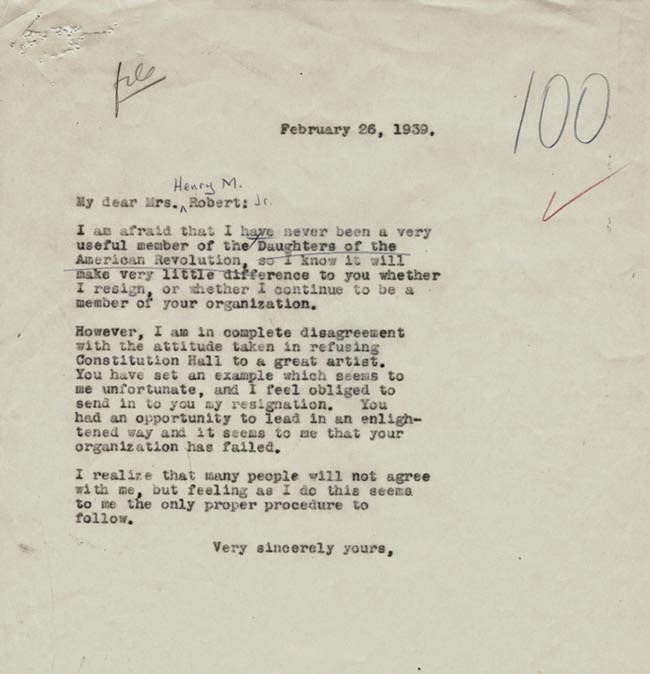
February 26, 1939 - Was the date of resignation from the Daughters of the American Revolution. This was a direct result of the organization adhering to local racial restrictions and refusing to rent its Constitution Hall for a concert by opera singer Marian Anderson. While she was not responsible for, nor attended the ensuing public concert byAnderson on the steps of the Lincoln Memorial two months later, she strongly supported it. Two months after that, she had Anderson sing in the White House for the King and Queen of England .
February 26, 1939 - Was the date of resignation from the Daughters of the American Revolution. This was a direct result of the organization adhering to local racial restrictions and refusing to rent its Constitution Hall for a concert by opera singer Marian Anderson. While she was not responsible for, nor attended the ensuing public concert by
Fun Fact:
Tuesday, May 13, 2014
Eleanor Roosevelt Human Rights Speech
This short video clip is a real recoding produced by the FDR library and show Mrs. Roosevelt as an independent thinker, who takes time to educate the world and share her ideals, and the importance of human rights.
Writtings and artifacts
![]() |
| This is a telegram sent from the first lady to John Lovell, Jr. of Howard University. February 26, 1939 |
See a rough draft of Eleanor's news column speaking about the DAR here.
Monday, May 12, 2014
Who is Marian Anderson?
Marian Anderson was born in 1897 in South Philadelphia. At the heart of their community stood the Union Baptist Church. It was within these walls
that Marian first began to sing. In this church was where she was soon ushered into the adult choir and her talent began to shine through at the age of 14. The church started a fund called the "Marian Anderson's Future Fund,"because they had such great faith in her ability to go far. Italian voice master, Giuseppe Boghetti remembers
this first meeting as occurring "at the end of a long hard day, when I
was weary of singing and singers, and when a tall calm girl poured out
‘Deep River' in the twilight and made me cry." While Philadelphia
conservatories turned Marian away with the refusal, "We don't take
colored," she quickly acquired influential fans who would aid her
career. She went on to participate in a competition and that win prompted a European tour that brought about great fame among the people of Europe and she turned into a coveted performer. Despite the fact that she was the country's third highest
concert box office draw, Marian was still subject to the racial bias of
the time, especially in the United States. The situation with the DAR brought about action by the first lady Eleanor Roosevelt and she was invited to sing at the steps of the Lincoln memorial on Easter Sunday. Feeling the meaning of the occasion, Marian had
tears in her eyes when she delivered "Nobody Knows the Trouble I've Seen" and "America" with heart-breaking pathos. The event was so
momentous and inspiring that the D.A.R. finally invited Marian to sing
at the Hall in 1943 for a war relief concert. At that event, both black
and white concert-goers attended.| Marian Anderson was the first African American invited to perform at the White House |
In 1958 she was officially designated delegate to the United Nations, a formalization of her role as "goodwill ambassador" of the U.S. she played earlier, and in 1972 she was awarded the UN Peace Prize.
Marian Anderson Sings at Lincoln Memorial
This video show Marian Anderson on the steps of the Lincoln memorial Easter Sunday 1939. The recording allows you to hear her famous voice ring out to the ears of 75,00 people of all races gathering to hear a free concert and come together to her an African American singer preform in spite of the support against the concert.
Conclusion
I hope you enjoyed this stroll through a little piece of history. As you may have realized these two women have been extremely influential in multiple aspects. Eleanor Roosevelt is arguably the most influential first lady in history and her efforts to expel civil injustices has had rippling effects that spill over into even today. Marian Anderson crushed cultural boundaries and united people pf all races with her melodious voice and pride in her talent. Both women effected the others cause in positive manors and the singing at the Lincoln memorial that Easter Sunday was just one small example of what can happen through a few simple decisions. The aim of this exhibit was to show how history can intertwine and effect change without people realizing it. Thank you for your interest and please feel free to further your interest through perusing some of these links and learning more aout these two amazing women of history.
| Click Here to be taken to the official FDR museum website |
Wednesday, May 7, 2014
Sources
Works
Cited
"Anna
Eleanor Roosevelt." The White House. The White House, n.d. Web. 01
May 2014.
"Franklin D. Roosevelt Presidential
Library and Museum." Franklin D. Roosevelt
Presidential
Library and Museum.
N.p., n.d. Web. 04 May 2014.
Roark, Johnson,
Cohen, Stage, Hartman. The American Promise 5th edition A history
of
the
United States, Boston:
Bedford/St. Martin’s., 2002. Print.
Roosevelt,
Eleanor. The Autobiography Of Eleanor Roosevelt. New York : Harper &
Bros.,
1961. Print.
Roosevelt,
Eleanor. This I Remember. New York: Harper 1949. Print
10 Things You May Not Know About the Roosevelts." History.com. A&E Television Networks, 20
Dec. 2012. Web. 13 May 2014.
10 Things You May Not Know About the Roosevelts." History.com. A&E Television Networks, 20
Dec. 2012. Web. 13 May 2014.
Urdang, Ivy P.
"Franklin And Eleanor Roosevelt: Human Rights And The Creation Of
The
United Nations." OAH Magazine Of History 22.2 (2008): 28-31. Academic
Search
Premier. Web. 4 May
2014.
Video Links:
http://youtu.be/9yzakVOdh6k
From the official FDR library YouTube account.
Video Links:
http://youtu.be/9yzakVOdh6k
From the official FDR library YouTube account.
http://youtu.be/mAONYTMf2pk
Subscribe to:
Posts (Atom)